
Lifestyle-Enhancing IOLs
An intraocular lens (IOL) is an artificial lens that restores vision after a cataract is removed. With today’s premium IOL technology, the right lens does more than bring sight back. It can be tailored to your daily activities, hobbies and priorities, lifting both your vision and your quality of life.
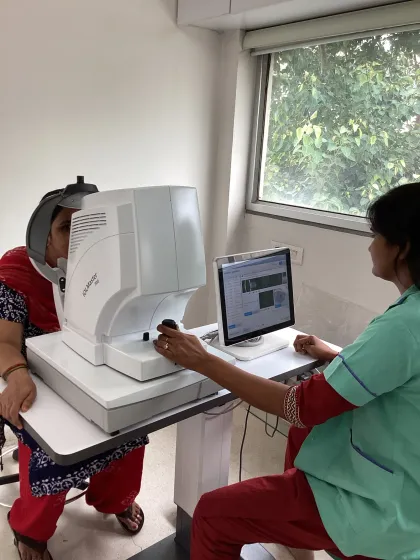
In the past, before IOLs existed, patients had to wear very thick spectacles to see after cataract surgery. Today an intraocular lens (IOL) goes in during the very same surgical sitting, so those thick glasses are a thing of the past. The lens you choose stays in your eye for life, which is why it is the single most important decision you make about your cataract surgery.
Types of IOL for cataract surgery
Every premium IOL is defined by two independent choices: how many focal points it has (monofocal or multifocal) and whether it corrects astigmatism (non-toric or toric). Combining these gives the four options we fit most often — monofocal non-toric, monofocal toric, multifocal non-toric and multifocal toric — plus aspheric optics and protective UV filters that can be built into any of them.
Monofocal IOL (single-focus lens)
A monofocal IOL gives you sharp, best-corrected vision at one distance, usually set for distance with reading glasses for near work. It is the most proven lens type, with decades of safe use behind it.
The types of monofocal lens vary in two ways: the optic can be spherical or aspheric — aspheric optics give better contrast and night vision — and the lens can be non-toric or toric, where a toric monofocal also corrects astigmatism. So “monofocal” is really a family covering spherical, aspheric, non-toric and toric variants.
Toric IOL — corrects astigmatism
A toric lens for cataract surgery is an IOL with astigmatism correction built into the optic. If your cornea is not evenly curved — astigmatism — a standard lens leaves vision blurred at every distance. People with significant astigmatism are usually most satisfied with a toric IOL, which is aligned to a precise axis during surgery so it neutralises the astigmatism.
Multifocal IOL — distance and near
A multifocal IOL has more than one focal point, so it corrects distance and near (and often intermediate) vision, cutting your dependence on glasses. It takes 6–12 weeks for the brain to adapt after second-eye surgery. Some people notice glare or haloes at night; most adapt well, though frequent night drivers may prefer a monofocal lens.
Multifocal toric IOL — astigmatism plus multifocality
A multifocal toric IOL combines both technologies: multiple focal points for glasses-free range and astigmatism correction. It is the right choice for someone who has meaningful astigmatism and also wants to reduce their need for glasses across distances.
Aspheric optics and protective filters
Any of the lenses above can be ordered with aspheric optics for sharper contrast, and with UV or blue-light protective filters that shield the retina from damaging light. These are enhancements to a lens, not separate lens types.
Comparing the four IOL options
| IOL type | Focal points | Corrects astigmatism | Glasses after surgery |
|---|---|---|---|
| Monofocal non-toric | One (usually distance) | No | For near — and for astigmatism if present |
| Monofocal toric | One (usually distance) | Yes | For near |
| Multifocal non-toric | Distance + near / intermediate | No | Rarely, but not for astigmatism |
| Multifocal toric | Distance + near / intermediate | Yes | Rarely |
How we choose the right IOL for you
At My Vision Eye Care in Ahmedabad, we only fit the lens after a complete eye examination and precise measurement of your eye. We then advise on the most suitable option, whether a monofocal non-toric, monofocal toric, multifocal non-toric or multifocal toric IOL, chosen around your eyes and the way you actually live. Our guiding principle with any lens is simple: long-term safety is better than short-term gains. You can read how the lens fits into the wider procedure on our Cataract Solutions page.
Lifestyle-Enhancing IOLs — your questions answered
How does an IOL help?
An IOL of the appropriate power gives you the best possible single vision — far, intermediate or near. The choice depends partly on your eye’s measurements and partly on how you feel about wearing glasses for reading. Most people still need glasses for the distances the IOL doesn’t correct, but choosing a premium IOL can reduce that need.
What are the different types of IOL for cataract surgery?
Every IOL is defined by two choices: how many focal points it has (monofocal or multifocal) and whether it corrects astigmatism (non-toric or toric). That gives four main options — monofocal non-toric, monofocal toric, multifocal non-toric and multifocal toric — plus aspheric optics and protective UV filters that can be added to any of them.
What are the types of monofocal lens?
A monofocal (single-focus) lens comes in a few variants. The optic can be spherical or aspheric — aspheric optics give better contrast and night vision — and the lens can be non-toric or toric, where a toric monofocal also corrects astigmatism. So "monofocal" covers spherical, aspheric, non-toric and toric types, all set for one focal distance.
What is a toric lens for cataract surgery?
A toric lens for cataract surgery is an IOL with astigmatism correction built into the optic. If your cornea is not evenly curved (astigmatism), a standard lens leaves vision blurred at every distance. A toric IOL is aligned to a precise axis during surgery to neutralise that astigmatism, and can be either monofocal toric or multifocal toric.
What is a multifocal toric IOL?
A multifocal toric IOL combines two technologies in one lens: multiple focal points for glasses-free distance and near vision, plus astigmatism correction. It suits someone who has meaningful astigmatism and also wants to reduce their dependence on glasses across distances.
What are the important criteria when choosing an IOL?
Every IOL differs in material, size, shape and design — which together determine its inertness in the eye, biocompatibility, stability, power accuracy and tendency to develop posterior capsule opacification (PCO). It’s equally important to choose an IOL from a company with stringent quality control. Opt for an IOL with a proven, long-term good track record on all of these.
Is it true I may not need glasses after IOL implantation?
For most people, no — that’s not fully true. Except for a small number of eyes with pseudo-accommodation, the majority will still need glasses for selective activities. An IOL reduces the need for glasses; a premium IOL reduces it further.
What is a multifocal or accommodative IOL?
These newer lenses reduce (but don’t eliminate) the need for glasses. It usually takes 6–12 weeks after second-eye surgery for the brain to adapt fully. Some people notice glare or haloes around lights at night; most adapt well, though frequent night drivers may prefer monofocal IOLs.
What are protective IOL filters?
Some IOLs include filters that protect the retina from UV and other potentially damaging light radiation. These are an enhancement built into a lens, not a separate lens type.
Does everybody benefit from premium IOLs?
- Not everyone benefits equally in terms of vision, but premium IOLs offer more safety to the eye.
- Even the most expensive IOL cannot restore a young natural lens or make up for deficits in other eye structures.
- People who have had previous eye surgery need careful evaluation, as prior surgery can affect IOL power calculation.
Related care
All services Glaucoma Glaucoma is a leading cause of blindness after 60 — yet blindness from it can often be prevented with early detection and timely treatment.
  Laser Procedure Quick, in-office laser treatment for two conditions, clouding after cataract surgery (PCO) and the prevention of a painful angle-closure glaucoma attack.